
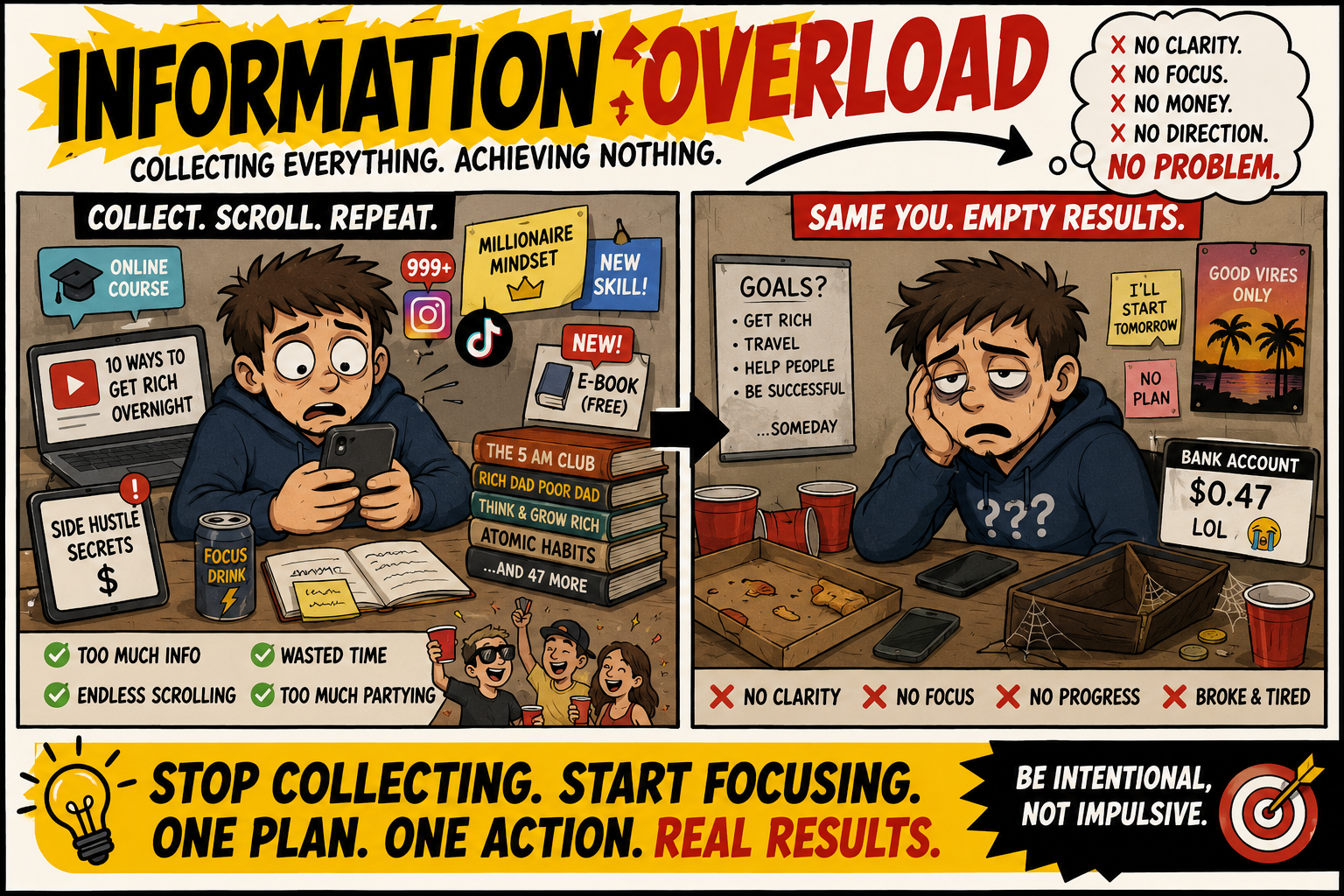

Why Consuming More Information Might Be The Exact Reason You’re Making Less Progress
We live in an age where knowledge has never been more accessible. Within seconds, you can watch tutorials on YouTube, listen to expert podcasts, enroll in online courses, or ask AI to answer almost any question. Information that once required years of research is now available with a simple search.
Yet despite this unprecedented access to knowledge, many people still struggle to make meaningful progress toward their goals. The challenge isn’t that people lack information—it’s that they’re overwhelmed by it. Instead of helping us move forward, an endless stream of content often makes it harder to decide what deserves our attention.
If you’ve ever found yourself saving videos to watch later, bookmarking dozens of articles, purchasing courses you never finish, or constantly switching between new ideas, you’re experiencing something psychologists call information overload. The more information we consume without applying it, the more difficult it becomes to focus and take meaningful action.
The Hidden Cost Of Information Overload
It’s natural to believe that learning more will help us make better decisions. Education is valuable, and expanding your knowledge is an important part of personal and professional growth. However, there is a point where continually gathering information begins to produce diminishing returns.
Research in cognitive psychology suggests that our brains have limited working memory. When we’re constantly processing new ideas, strategies, and opinions, it becomes increasingly difficult to organize, prioritize, and act on what we’ve learned. Instead of creating clarity, excessive information often creates mental clutter.
Every new productivity system, business model, investment strategy, or self-improvement technique introduces another choice. Those additional choices require mental energy, and over time they contribute to decision fatigue—the reduced ability to make effective decisions after repeatedly weighing multiple options throughout the day.
Why More Knowledge Doesn’t Always Lead To Better Results
Many people assume that successful individuals simply know more than everyone else. In reality, expertise is built through a combination of learning and consistent application. Reading about a skill and practicing that skill are two very different experiences.
For example, someone can spend months studying entrepreneurship, fitness, or investing without ever taking meaningful action. Meanwhile, another person with less theoretical knowledge but greater consistency may achieve better results simply because they’re applying what they already know.
Knowledge creates potential, but execution creates outcomes. Without implementation, even the best ideas remain ideas.
Why Ambitious People Often Struggle The Most
Ironically, information overload tends to affect highly motivated people. Individuals who care deeply about improving themselves are naturally drawn to books, podcasts, educational videos, and expert advice because they genuinely want to make smarter decisions.
The problem arises when the pursuit of the “perfect” strategy becomes a substitute for action. Instead of moving forward with one approach, people continue searching for better answers, convinced that one more book or one more course will eliminate uncertainty.
In reality, uncertainty is part of every worthwhile goal. Waiting until you have complete certainty often delays progress indefinitely.
The Psychology Of Analysis Paralysis
Behavioral researchers often describe a phenomenon known as analysis paralysis, where having too many options makes it harder to make any decision at all. Rather than feeling empowered by more choices, people become hesitant because they fear choosing the wrong path.
This happens in business, education, careers, and everyday life. Should you start freelancing or build an online store? Learn coding or digital marketing? Watch another tutorial or begin your first project?
The longer these decisions remain unresolved, the less progress gets made. Choosing one reasonable path and committing to it usually produces better results than endlessly evaluating every possible option.
The Competitive Advantage Of Focus
One characteristic shared by many high performers is not that they consume more information than everyone else—it’s that they filter information more effectively. They understand that attention is a limited resource and protect it carefully.
Rather than pursuing every new trend, they identify one meaningful objective, develop a plan, and stay committed long enough to measure real progress. They recognize that mastery comes from repetition and consistency, not constant switching between strategies.
Focus allows small improvements to accumulate over time. Those incremental gains eventually compound into significant long-term results.
The Difference Between Learning And Avoiding Action
Learning is essential, but it’s important to recognize when learning becomes procrastination. Sometimes we convince ourselves that more preparation is necessary when, in reality, we’re avoiding the discomfort of taking action.
Watching another tutorial often feels productive because we’re still engaged with our goal. However, unless that information is immediately applied, very little changes. Progress occurs when knowledge moves from theory into practice.
A helpful question to ask yourself is:
“Am I learning something I need right now, or am I delaying the work I already know I should be doing?”
Honest answers to that question can dramatically improve productivity.
A Simple Framework For Managing Information
Instead of trying to consume everything, develop a system for filtering information intentionally.
1. Does this support my current goal?
Every article, podcast, video, or course should have a clear connection to the outcome you’re trying to achieve. If it doesn’t directly move you closer to that objective, consider saving it for another time instead of interrupting your current focus.
2. Am I learning because I need this information, or because I’m avoiding action?
Preparation has value, but endless preparation often becomes a form of procrastination. If you’ve already learned enough to begin, taking the first step usually teaches you more than consuming another hour of content.
3. What’s one action I can take immediately?
After every book, video, or lesson, identify one specific action you can complete today. Turning knowledge into behavior is what transforms information into measurable progress.
The Long-Term Benefits Of Focus
Focus does more than improve productivity—it builds confidence. Every time you follow through on a commitment and complete meaningful work, you reinforce your ability to trust yourself.
Over time, this creates positive momentum. You spend less energy second-guessing decisions, comparing yourself to others, or chasing every new opportunity because you’re seeing progress from consistent execution.
Confidence is rarely built by knowing more. It’s built by repeatedly proving to yourself that you can take action and produce results.
Information Is Abundant. Attention Is Limited.
Today’s challenge isn’t finding information—it’s deciding what deserves your attention. With unlimited content competing for your time, your ability to filter distractions has become one of the most valuable skills you can develop.
The people who achieve meaningful results are rarely those who consume the most information. More often, they’re the ones who choose a direction, commit to consistent action, and resist the temptation to constantly change course.
Final Thoughts
You probably don’t need another productivity app, another online course, or another expert telling you what to do. Chances are, you already know the next step you should take.
Progress doesn’t come from collecting more ideas. It comes from consistently applying the knowledge you already have.
Choose one goal.
Focus on one priority.
Take one meaningful action every day.
Because in a world overflowing with information, your greatest competitive advantage isn’t knowing more—it’s executing better.



Hi, this is a comment.
To get started with moderating, editing, and deleting comments, please visit the Comments screen in the dashboard.
Commenter avatars come from Gravatar.