

How a convenience store owner can create a new income stream with affiliate marketing
Someone walks into your store for a drink, a bag of chips, and a phone charger.
You have the drink. You have the chips. But the charger they need? You don’t carry it.
Usually, that’s where the opportunity ends.
But what if you could help them find the right charger—and earn a commission when they buy it?
That’s the idea behind the Convenience Genius: a store owner who sees income opportunities in the everyday problems customers bring through the door.
Your shelves have limited space. Your ability to help customers can reach much further.
What is affiliate marketing?
Affiliate marketing means earning a commission for referring customers to another business.
You join an affiliate program, receive a special tracking link, and use that link to recommend eligible products or services. When someone clicks and completes a qualifying purchase or action, you may earn a commission under the program’s rules.
The other business handles the sale and fulfilment. Your job is to help the customer discover something useful.
Think of it as a digital extension of your store: a place for helpful recommendations you don’t need to keep in your stockroom.
Meet the owner who started paying attention
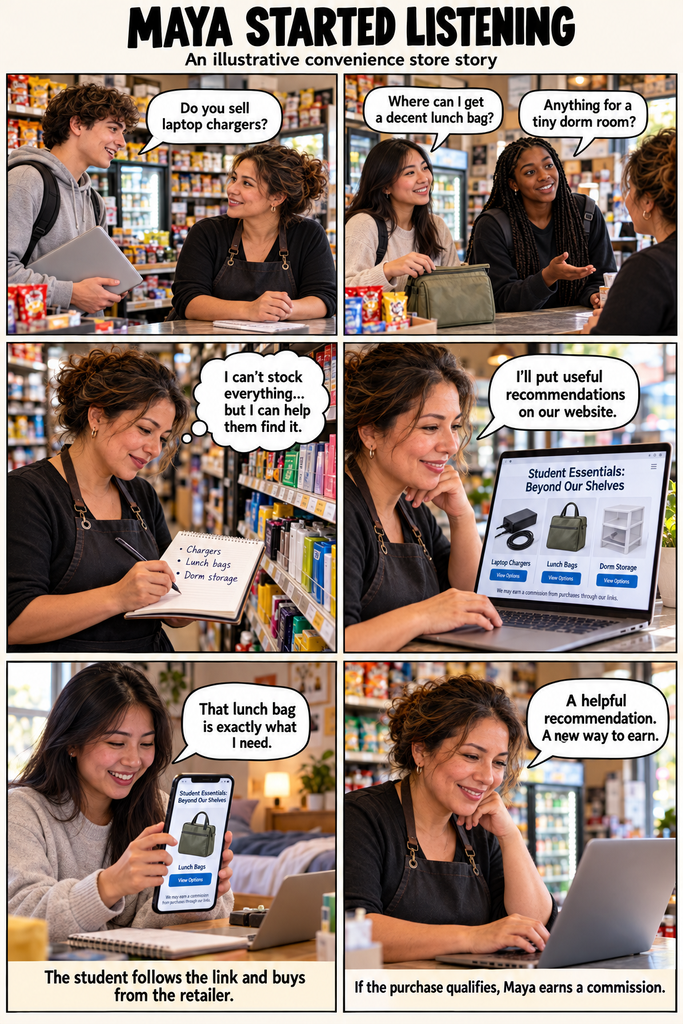
Imagine Maya owns a convenience store near a college.
Every week, students ask similar questions:
“Do you sell laptop chargers?”
“Where can I get a decent lunch bag?”
“Do you have anything to help organize a tiny dorm room?”
Maya can’t stock everything. She has limited shelf space and doesn’t want money tied up in products that might sit untouched.
So she starts writing down what people ask for.
Then she creates a page on her store’s website called “Student Essentials: Beyond Our Shelves.”
It features a small selection of products available through affiliate programs she has been approved to join. Each recommendation explains who it might suit, why it’s useful, and anything customers should check before purchasing.
A student who visits her website might discover a lunch bag, follow the retailer’s link, and buy it. If the purchase qualifies, Maya earns a commission.
This is an illustrative example, but the opportunity is straightforward: questions she already hears can become useful content that supports another source of income.
Start with the customer, then choose the product
The strongest starting point is a question:
“What do my customers need that I can’t currently provide?”
Your location can give you clues.
| If your store serves… | Potential affiliate products to investigate |
|---|---|
| College students | Desk organizers, laptop accessories, compact storage |
| Commuters | Travel mugs, lunch bags, portable chargers |
| Travellers | Luggage organizers, travel adapters, travel accessories |
| Local families | Household organizers, reusable shopping bags, lunch containers |
These are ideas to research, not guaranteed affiliate opportunities. Check whether a suitable program exists, accepts your business, and serves your customers’ location.
Choose products you can explain honestly. If you haven’t used something, don’t describe it as personally tested.
Build a small, useful recommendation page
You don’t need hundreds of links. Start with five relevant recommendations.
For each one, answer:
- What problem does this solve?
- Who is it useful for?
- What should someone check before buying?
For example, a travel-adapter recommendation should explain that customers need to check compatibility with their destination and devices.
That detail gives someone a reason to trust your page. A wall of unexplained “Buy Now” buttons doesn’t offer the same value.
Make it clear that purchases happen through another retailer, with that retailer’s delivery and return policies.
Get people to the page—within the program’s rules
Your store’s website and approved social accounts can help customers discover your recommendations.
You could publish useful posts such as “Five Things Students Ask Us For Every September” or demonstrate how to choose a lunch bag that fits a full day on campus.
Check the affiliate program’s promotional rules before using signs, receipts, QR codes, emails, or other channels. Permission varies. For example, Amazon.ca says its special affiliate links cannot be used in offline promotions or printed materials. Don’t assume you can place every affiliate link beside your cash register.
Choose a program whose permitted methods fit how you plan to reach customers.
Be clear about how you earn
Customers should understand when a recommendation could earn your business money.
A simple disclosure might say:
“We may earn a commission if you buy through links on this page.”
Place it where customers will see it alongside your recommendations, and include any additional wording your program requires.
Canada’s Competition Bureau says material connections—including commissions—should be clearly disclosed, and reviews and testimonials should reflect actual experience.
Transparency helps customers make informed decisions while protecting the trust your store depends on.
What could the income look like?
Here’s a hypothetical example:
Suppose your referrals generate 40 qualifying purchases in one month, averaging $50 each, with a 5% commission.
40 purchases × $50 × 5% = $100 in affiliate revenue.
That’s an illustration, not an earnings forecast. Actual results depend on traffic, purchases, commission rates, attribution rules, and returns. Website costs and the time spent creating content also affect whether the effort pays off.
Start small. Track clicks, confirmed commissions, and the questions customers keep asking. Expand when the results justify it.
Your next income idea could be a customer’s next question
For the next week, write down every request you can’t fulfil.
Look for one repeated need. Research a suitable affiliate program. Build one helpful page and measure what happens.
You don’t need to turn your convenience store into a completely different business.
You already help people solve everyday problems. Affiliate marketing can give you another way to do that—and, when a referral qualifies, another way to get paid.
That’s the Convenience Genius: noticing the opportunity in “Do you sell this?”
Ready to become a Convenience Genius?
Your next income idea could start with a question your customers already ask. Take the first step toward exploring affiliate marketing and how it could fit your business.
👉 Explore Wealthy Affiliate here
Disclosure: This is an affiliate link. I may earn a commission if you make a purchase through it.